
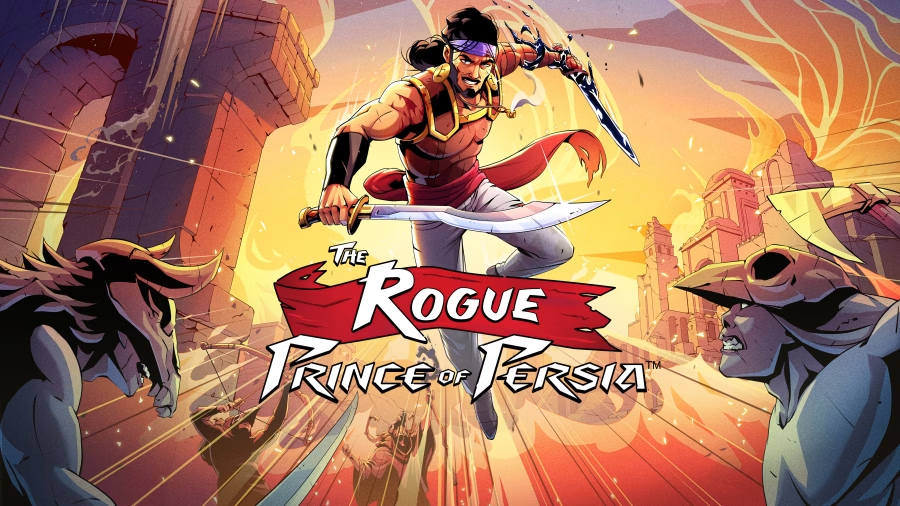
The Rogue Prince of Persia is a 2D action-platformer roguelite developed by Evil Empire, the studio famous for its extensive work on Dead Cells, and published by Ubisoft. Representing a fast-paced, highly replayable departure from traditional linear entries, this title brings a fresh pulse to the iconic franchise.c franchise.

While the game has evolved in Early Access since May 2024, significant enhancements to the combat and story have arrived just in time for the full 1.0 release. With physical editions hitting PlayStation 5 and Nintendo Switch on April 10th, there has never been a better time to dive into the Prince’s latest journey.
The Story: Rewinding the Fate of Ctesiphon
Set in a vibrant reimagining of the Persian capital, Ctesiphon, the narrative follows the Prince as he attempts to save his city from a Hunnish army corrupted by dark shamanic magic.
The Prince possesses a mystical bolo that justifies the roguelite loop, allowing him to rewind time upon death. This mechanic lets players experiment with different paths and strategies, uncovering new lore and character motivations with every run as they seek to stop the Hunnish leader.


Gameplay Mechanics: How the Prince Moves
As a massive fan of roguelites, I was eager to see how the caretakers of Dead Cells (Motion Twin handed development of the game to Evil Empire in 2019) would tackle the Prince of Persia formula. They’ve successfully respected the DNA of both the original and 3D iterations while adding their own signature magic:
- Fluid Acrobatics: The signature wall-run returns in a 2.5D plane, allowing players to move seamlessly between the foreground and background to avoid traps or flank enemies. The flow state achieved by combining wall-jumps and dodges is dynamic and exceptionally fun.
- Dynamic Free-Flow Combat: The combat is a high point, featuring a diverse arsenal from swords and clubs to spears and gauntlets. A well-placed kick sending an enemy tumbling into a wall of spikes remains one of the most satisfying ways to clear a room.
- The Medallion System: Players collect glimmers and blueprints to unlock permanent upgrades and medallions. These chainable buffs provide elemental effects, such as leaving a trail of fire while wall-running or releasing poison clouds upon a parry.
- Vibrant Art & Sound: Moving away from gritty realism, the game adopts a bold, striking style inspired by modern Franco-Belgian comics. This is paired with an eclectic “Persian Trap” soundtrack that blends traditional instruments with modern electronic beats.
The Verdict
Exploring the different biomes, leaping from walls to poles and ledges then dropping down and unleashing combos on enemies is exhilarating and truly fun. The ever rewarding loop of items, weapons, missions and companions to meet is remarkable in it’s ability to encourage just one more run.


While the game is outstanding, though I did encounter occasional difficulty spikes that could hamper a well-orchestrated run. Additionally, while the biome diversity is strong, it feels slightly more limited compared to titans of the genre like Hades II.
Regardless of these small quibbles, The Rogue Prince of Persia is an exceptional roguelite with amazing depth and animation flair. I’ve put in dozens of hours and still find myself popping back in to experience it’s addictive loop of combat and exploration.

The Rogue Prince of Persia is available now on PC (Steam), Xbox Series X|S, Nintendo Switch, and PS5. Physical releases for PS5 and Switch arrive April 10th. (Review code provided by Ubisoft for PS5).